Fun Academic Projects
A curated subset of projects from my academic journey. This is not an exhaustive list, but a selected set of builds that significantly shaped how I approach robotics, controls, simulation, and system integration.
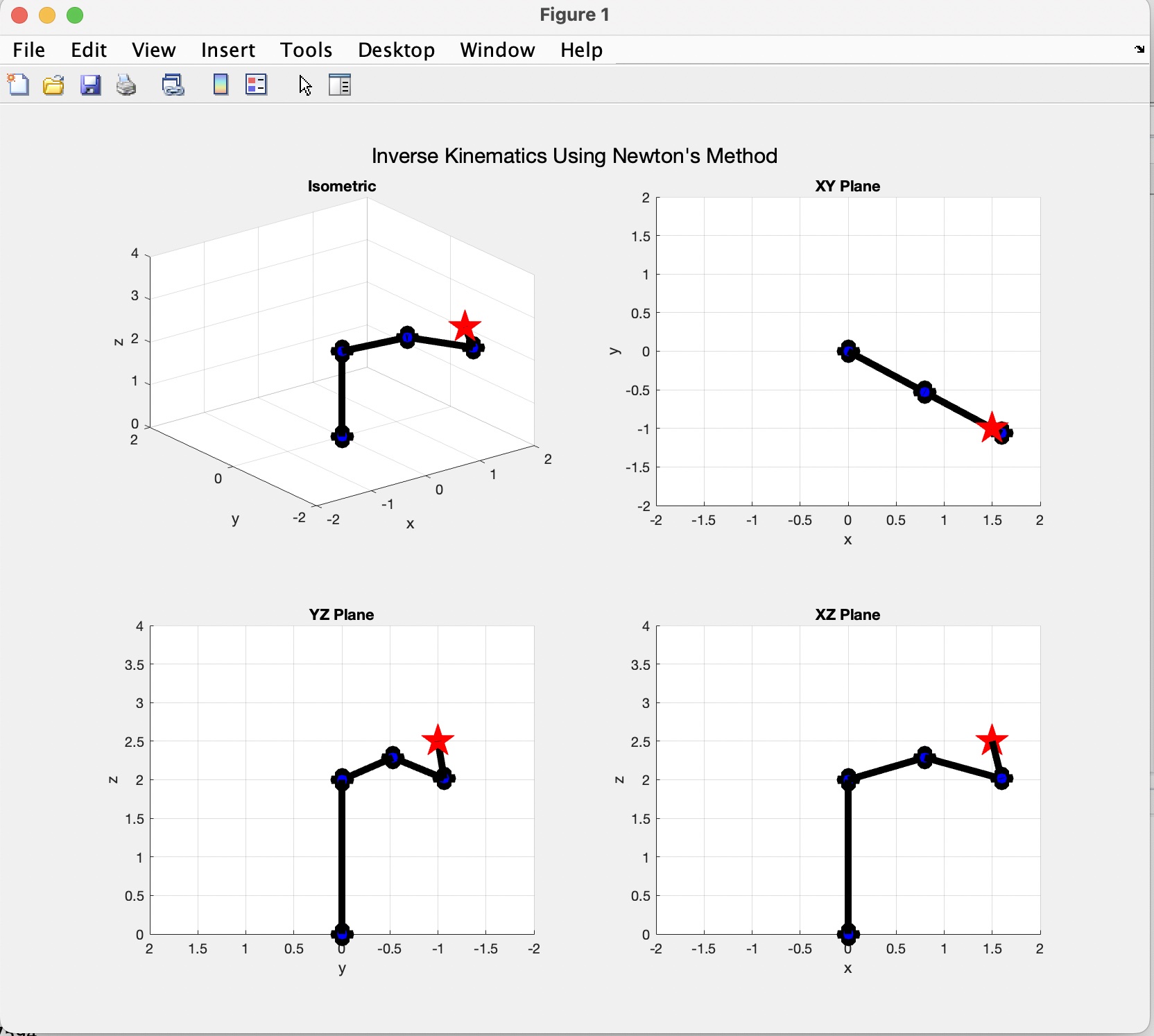
Inverse Kinematics project figure (user-selected hub image).
ME594 - Numerical Methods in Mechanical Engineering
The Inverse Kinematics of a 4-DOF RRRR Manipulator in 3D Space via Newton's Method: A Comparison to the Geometric Approach
Implemented a Newton-based inverse kinematics solver for a 4-DOF RRRR manipulator in 3D and compared it against geometric IK. The work focused on practical tradeoffs among solver generality, convergence behavior, and runtime, while also demonstrating how one numerical workflow can support multiple configurations without repeated symbolic re-derivation.
Simulation snapshot from APF vs TPRR comparison.
ME650 - Robot Manipulators
Obstacle Avoidance for an 8-DOF 8R Manipulator in 2D Space via Task Priority Redundancy Resolution and Artificial Potential Field Methods
Implemented Artificial Potential Field (APF) and Task Priority Redundancy Resolution (TPRR) on an arbitrary 8-DOF manipulator and compared their behavior under the same simulation conditions. The project emphasized convergence reliability, obstacle-clearance control, and parameter-tuning effort to evaluate which method is more practical for robust engineering use.
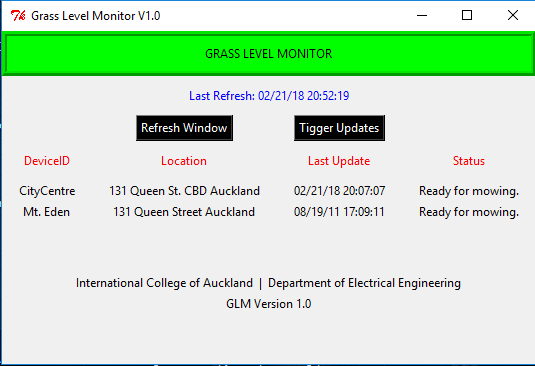
Operator dashboard with DeviceID, location, update time, and status.
DEE700 - Final Project
Grass Level Monitor via Image Processing Using Python
Designed and implemented a cloud-connected IoT monitoring system that classifies grass condition from camera data and provides remote mowing-readiness visibility through AWS services and a Python frontend. The project integrated edge sensing, cellular/cloud communication, data persistence, and operator-facing status visualization into a complete end-to-end workflow.
Additional Projects (Documentation Lost)
Earlier academic builds that remain important to my technical foundation even though full reports are no longer available. These projects reflect core hands-on training in electronics, communications, and automation that supported later robotics and research work.
DC Power Supply
Mapua Institute of Technology, Manila, Philippines • 2010
- Designed and prototyped a low-power DC supply targeting stable 12V constant output.
- Focused on component-level power regulation behavior and practical bench validation.
- Strengthened analog electronics fundamentals and hardware troubleshooting discipline.
AM/FM Radio Receiver
Mapua Institute of Technology, Manila, Philippines • 2009
- Designed and built an AM/FM receiver prototype capable of tuning local commercial channels in Manila.
- Applied RF and communication principles in circuit realization, tuning, and signal verification.
- Built practical intuition on front-end reception quality and analog signal conditioning.
Antenna Receiver for Television (Yagi-Uda)
Mapua Institute of Technology, Manila, Philippines • 2010
- Designed and fabricated an outdoor Yagi-Uda TV antenna for terrestrial analog reception.
- Validated multi-channel reception performance (10+ local channels) in real deployment conditions.
- Developed hands-on understanding of directional gain, alignment sensitivity, and practical antenna behavior.
Automatic Size-Sorting Conveyor
Mapua Institute of Technology, Manila, Philippines • 2011
- Designed and prototyped an analog-controlled size-sorting conveyor using relays, lasers, LDRs, and reversible DC motors.
- Implemented sensing-to-actuation logic to classify objects by size and route them through mechanical flow paths.
- Designed supporting PCB in Altium, integrating circuit design with physical automation behavior.
Microwave Telecommunication System Design
Mapua Institute of Technology, Manila, Philippines • 2011
- Developed a theoretical microwave backbone design connecting five base stations across Camarines Norte and Quezon.
- Engineered the link budget and planning assumptions toward 99.99% reliability target.
- Strengthened systems-level telecom design reasoning under reliability and network-coverage constraints.